Vietnamese Seafood Guide: 12 Dishes I’ve Learned to Order in Vietnam
When I first came to Vietnam, I thought I already understood seafood fairly well.
I’m Korean, after all.
Seafood is a big part of Korean food too. I grew up eating grilled fish, shellfish, squid, crab, shrimp, and all kinds of seafood.
So when I moved to Da Nang, I didn’t expect Vietnamese seafood culture to feel particularly unfamiliar.
I was wrong.
The ingredients themselves often looked familiar. What felt different was the way people ordered them, cooked them, and shared them around the table.
At many seafood restaurants in Da Nang, you don’t simply sit down, point at a finished dish on the menu, and wait.
You might first walk over to tanks filled with live seafood.
You choose what you want.
Then you choose how it should be cooked.
Steamed with lemongrass?
Grilled with scallion oil?
Stir-fried with tamarind?
Garlic butter?
Sa tế?
Salt and chili?
The first few times, I remember thinking there were almost too many choices.
After living here for a while, though, this became one of the things I enjoy most about eating seafood in Vietnam.
Vietnamese seafood isn’t really about one famous dish.
It’s about taking fresh ingredients and changing the experience completely depending on the cooking method, herbs, seasoning, and dipping sauce.
Here are 12 Vietnamese seafood dishes and styles I think are worth trying, especially if you are visiting a coastal city like Da Nang.

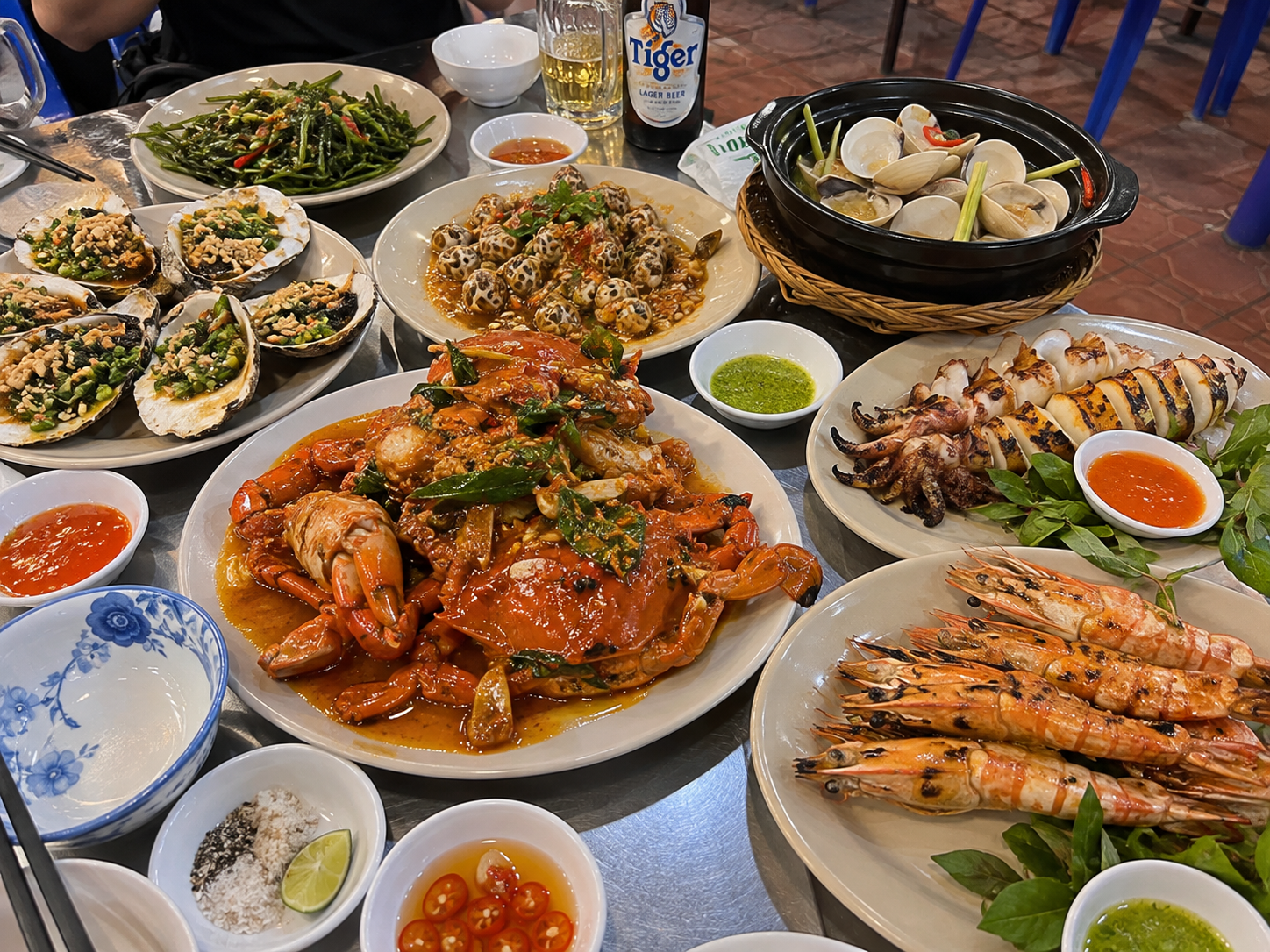
1. Nghêu Hấp Sả — Clams Steamed with Lemongrass
If someone is trying Vietnamese seafood for the first time, this is one of the dishes I would recommend immediately.
Nghêu hấp sả is clams steamed with lemongrass.
It sounds extremely simple.
And it is.
But that is exactly why it works.
The clams release their natural sweetness into the broth while the lemongrass gives it a fresh citrus aroma. Depending on the restaurant, you may also find chili, herbs, or a little ginger in the pot.
What surprised me at first was how much I enjoyed the liquid at the bottom.
It isn’t really a heavy soup.
It’s light, slightly salty, fragrant, and full of clam flavor.
Sometimes I end up drinking more of the broth than I expect.
For someone who is worried that Vietnamese seafood might be too spicy or too strongly seasoned, this is a very easy place to start.

2. Hàu Nướng Mỡ Hành — Grilled Oysters with Scallion Oil
Oysters are common at seafood restaurants in Da Nang, but one preparation appears again and again:
Hàu nướng mỡ hành.
The oysters are grilled in their shells and topped with scallion oil.
Depending on the restaurant, you may also get crushed peanuts, fried shallots, or a little chili on top.
This is completely different from eating a plain raw oyster.
The oyster becomes warm and juicy, while the scallion oil adds richness.
I especially like the contrast between the soft oyster and the slightly crunchy toppings.
This is also one of those dishes that often makes you order it after seeing it arrive at another table.
One tip: eat it while it is still hot.
Once grilled oysters sit around too long, they lose part of what makes them good.
3. Sò Điệp Nướng Mỡ Hành — Grilled Scallops with Scallion Oil
If you like the oysters, try the scallops next.
Sò điệp nướng mỡ hành uses the same basic idea: fresh shellfish, scallion oil, and a hot grill.
The scallops are usually cooked directly in their shells.
What I like about Vietnamese grilled scallops is that restaurants often don’t try to make them unnecessarily complicated.
Fresh scallop.
A little oil.
Scallion.
Maybe peanuts.
Maybe chili.
That’s enough.
One thing I’ve slowly learned after living in Da Nang is that fresh seafood often tastes better when the kitchen does less to it.
When the ingredient is good, it doesn’t need to be buried under a heavy sauce.

4. Cua Rang Me — Tamarind Crab
This is where Vietnamese seafood starts getting messier.
And much more fun.
Cua rang me is crab cooked in a sweet-and-sour tamarind sauce.
The sauce is sticky, tangy, slightly sweet, and savory.
You will probably need your hands.
You will probably get sauce on your fingers.
And you may spend more time cracking the crab than actually eating it.
That is normal.
Vietnamese seafood dinners are often not particularly elegant.
There are shells everywhere.
Small bowls start filling up with crab legs.
Someone is using a crab cracker.
Someone else is dipping bread into the sauce left on the plate.
I actually like that atmosphere.
A seafood dinner here often feels much less formal than a normal restaurant meal and much more social.
And don’t ignore the sauce after the crab is gone.
A piece of bread dipped into tamarind sauce can sometimes be almost as satisfying as the crab itself.

5. Tôm Nướng — Grilled Prawns
Vietnam has many ways to prepare shrimp and prawns, but grilled prawns are one of the simplest.
They are also one of the safest choices when ordering for a mixed group.
Large prawns may be grilled with:
- salt and chili
- garlic
- butter
- sa tế
- or almost no seasoning at all
When the prawns are fresh, I personally prefer the simpler preparations.
You can actually taste the sweetness of the shrimp.
This is something I’ve noticed repeatedly with seafood in Vietnam.
Tourists sometimes focus on which dish has the biggest sauce or the strongest seasoning.
But local diners also pay a lot of attention to whether the seafood itself is fresh.
With good prawns, that matters more.
6. Mực Nướng Sa Tế — Grilled Squid with Sa Tế
Mực nướng sa tế is grilled squid coated with a spicy chili-based seasoning.
Vietnamese sa tế is usually made with chili, oil, and aromatic ingredients, and the exact taste changes from one restaurant to another.
The result is smoky, spicy, and sometimes slightly sweet.
Squid works especially well with it because squid itself has a relatively clean flavor.
The difficult part is cooking squid correctly.
Good grilled squid should still have a little bounce when you bite it.
When it is overcooked, it becomes rubbery very quickly.
Whenever I get a good plate of grilled squid, the first thing I notice is usually the texture.
If you don’t handle spicy food well, ask for less chili.
The spice level can vary much more than you might expect.

7. Ốc Hương — Vietnamese Babylon Snails
Vietnamese snail culture probably deserves an entire article of its own.
Before living here, I never realized how many different kinds of snails could appear on one seafood menu.
One of the more popular types is ốc hương, usually called spotted babylon snail in English.
You may find it prepared with:
- garlic butter
- tamarind
- chili salt
- lemongrass
- coconut
- cheese
- spicy sauce
This was one of the biggest differences I noticed compared with the way I was used to eating shellfish in Korea.
The same basic seafood can become several completely different dishes depending on the sauce.
Once you start visiting Vietnamese ốc restaurants, the number of choices can feel almost ridiculous.
In a good way.
If you are trying snails for the first time, I would start with garlic butter or a simple grilled preparation.
They are usually easier to approach than some of the stronger sauces.
8. Sò Huyết — Blood Cockles
Blood cockles can look slightly intimidating if you have never eaten them before.
Their Vietnamese name is sò huyết.
They may be grilled, stir-fried with tamarind, cooked with garlic, or served with other seasonings.
The flavor is stronger than many other shellfish.
This is probably not the first thing I would order for someone who normally avoids shellfish.
But if you already enjoy mussels, clams, and oysters, they are worth trying.
One thing Vietnam has taught me is not to decide whether I like an ingredient based on one preparation.
A shellfish I don’t enjoy steamed can taste completely different with tamarind.
Something that tastes too strong on its own may work perfectly with chili salt and lime.
Vietnamese seafood makes experimenting easy.

9. Cá Nướng — Whole Grilled Fish
When a whole grilled fish arrives at a Vietnamese table, nobody normally thinks:
“Whose fish is this?”
It belongs to the table.
People take pieces little by little.
Depending on the fish and restaurant, it may be grilled with chili, salt, lemongrass, or other seasonings.
Sometimes it arrives with vegetables, fresh herbs, rice paper, and dipping sauce.
This part of Vietnamese dining culture felt very natural to me as a Korean.
Korean meals also involve sharing many dishes.
But Vietnamese meals often take the sharing idea even further.
A whole fish in the middle of the table, along with herbs, vegetables, rice paper, and sauce, can become an entire eating experience rather than just one dish.
If rice paper arrives with the fish, watch how the people around you eat it.
Usually those vegetables and herbs are there for a reason.
10. Ốc Xào Bơ Tỏi — Snails with Garlic Butter
Yes, another snail dish.
But it is almost impossible to talk about Vietnamese seafood without mentioning snails more than once.
Ốc xào bơ tỏi is one of the easiest versions for visitors to enjoy.
The shells are coated in a rich garlic butter sauce.
You often smell the garlic before the plate even reaches the table.
Depending on the type of snail, you may use a small metal pick to remove the meat.
It feels slightly awkward the first time.
After a few shells, you get used to it.
And there is another rule I learned pretty quickly:
Don’t waste the garlic butter sauce.
If bread is available, use it.
Some Vietnamese seafood dishes have a second meal hiding at the bottom of the plate.
The seafood disappears first.
Then everybody starts eating the sauce.

Description:
Vietnamese whole grilled fish served family-style with rice paper, fresh herbs, vegetables, and dipping sauces.
11. Lẩu Hải Sản — Vietnamese Seafood Hot Pot
Lẩu hải sản means seafood hot pot.
A pot of broth is placed in the middle of the table, then seafood, vegetables, mushrooms, and noodles are added little by little.
Shrimp.
Squid.
Clams.
Fish.
Whatever the restaurant includes.
The interesting part is that the broth changes as the meal continues.
At the beginning, it may taste relatively light.
After shrimp, clams, squid, and fish have been cooking in it for a while, the broth becomes sweeter and deeper.
By the time noodles are added near the end, the soup can taste completely different from when the meal started.
For me, hot pot also shows something important about Vietnamese food.
The meal is not only about what you eat.
It is about eating it together.
12. Cháo Hải Sản — Seafood Porridge
Seafood porridge probably isn’t the first dish tourists imagine when they hear “Vietnamese seafood.”
But I think it deserves more attention.
Cháo hải sản is rice porridge cooked with seafood.
Depending on the restaurant, it may contain shrimp, squid, fish, clams, or a mixture.
After a table full of grilled, spicy, buttery seafood, porridge feels completely different.
Warm.
Soft.
Comforting.
Vietnamese cháo reminds me somewhat of Korean juk, although the seasoning and toppings can be different.
That familiarity is probably one reason I enjoy it.
Sometimes the dish you remember most isn’t the largest lobster or the most expensive crab.
It’s the warm bowl you eat at the end of the meal.
Vietnamese Seafood Is Often About the Cooking Method
This was probably the biggest thing I had to learn.
When ordering seafood in Vietnam, asking:
“What seafood should I order?”
is only half of the question.
You also need to think about:
“How should it be cooked?”
The same clams, snails, squid, or crab can taste completely different depending on the preparation.
Here are some words that are useful to recognize:
| Vietnamese | Meaning |
|---|---|
| Hấp | Steamed |
| Nướng | Grilled |
| Xào | Stir-fried |
| Rang me | Cooked with tamarind |
| Mỡ hành | Scallion oil |
| Bơ tỏi | Garlic butter |
| Sa tế | Chili-based seasoning |
| Muối ớt | Chili salt |
| Hấp sả | Steamed with lemongrass |
Learning just these few words makes a Vietnamese seafood menu much easier to understand.
How Seafood Restaurants Work in Da Nang
This can confuse first-time visitors.
At many seafood restaurants, especially larger places near coastal areas, seafood may be displayed alive in tanks.
You choose what you want.
The staff weighs it.
Then you choose the cooking method.
For example, you might choose one crab and ask for it with tamarind sauce.
Or choose clams and ask for them steamed with lemongrass.
When I first started eating seafood here, I paid much more attention to the dish name.
Now I usually pay attention to three things:
the seafood, the weight, and the cooking method.
That makes ordering much easier.

Check the Price Before Ordering
This is probably the most practical advice in this article.
Seafood prices can change.
Size matters.
Season matters.
The type of seafood matters.
And a tank full of live seafood does not mean everything has the same price.
Before ordering an expensive item such as crab or lobster, confirm the price.
If it is sold by weight, confirm the weight too.
There is nothing embarrassing about asking.
Vietnamese customers do it as well.
It is much better to spend 20 seconds checking the price than to be surprised when the bill arrives.
Don’t Order Too Much at the Beginning
This is another easy mistake.
Seafood somehow looks smaller before it reaches the table.
You see some clams.
A crab.
A plate of squid.
A few prawns.
Maybe one snail dish.
Then everything arrives and suddenly there is almost no space left on the table.
Vietnamese seafood meals are usually shared, so I think ordering several different dishes is more enjoyable than ordering huge portions of one thing.
I prefer starting with fewer dishes.
If we are still hungry, we order more.
Seafood dinners here often last longer than eating a simple bowl of noodles anyway.
There is no reason to order half the menu in the first five minutes.
What Dipping Sauce Should You Use?
Seafood and dipping sauce are difficult to separate in Vietnam.
You may receive green chili salt sauce, red chili sauce, pepper with lime, fish sauce, or a restaurant’s own seafood sauce.
One combination I really enjoy is surprisingly simple:
fresh seafood with something salty, sour, and spicy.
When the seafood itself is naturally sweet, a little acidity makes a big difference.
I also wouldn’t cover good seafood with sauce before tasting it.
Try one bite first.
Dip the next one.
Sometimes only a tiny amount is enough.

What Should a Beginner Order?
If I were taking someone to a Vietnamese seafood restaurant for the first time, I wouldn’t begin with the strangest snail on the menu.
I would probably order:
Nghêu hấp sả
Clams steamed with lemongrass.
Hàu nướng mỡ hành
Grilled oysters with scallion oil.
Tôm nướng
Grilled prawns.
Mực nướng sa tế
Grilled squid with sa tế.
Cua rang me
Tamarind crab if there are enough people to share it.
Then I would add some vegetables, fried rice, or another simple side dish.
That gives you different textures and cooking styles without making the meal too adventurous.
After that?
You can start exploring the snail menu.
Good luck.
There are a lot of them.
Is Vietnamese Seafood Spicy?
Not necessarily.
Some dishes can be very spicy, particularly those made with chili, sa tế, or spicy dipping sauces.
Others are extremely mild.
Clams steamed with lemongrass, simply grilled prawns, and oysters with scallion oil can all be fairly gentle.
One advantage of Vietnamese seafood is that some of the heat comes from the dipping sauce rather than the seafood itself.
That means you can control the spice level.
And if there is a bowl of bright green or red chili sauce sitting on the table, don’t assume you need very much.
Vietnamese chili can be much stronger than it looks.
I learned that lesson fairly quickly.
Is Seafood in Da Nang Worth Trying?
For me, yes.
And not simply because Da Nang is next to the sea.
Seafood restaurants here show a side of Vietnamese dining culture that you don’t really experience from eating one bowl of phở.
People sit around a large table.
Food arrives gradually.
Everyone shares.
Someone is cracking a crab.
Someone is peeling shrimp.
Someone is trying to get a snail out of its shell.
There are dipping sauces everywhere.
Empty shells start piling up.
Another dish gets ordered.
Then somebody orders beer.
A simple dinner can easily become a long evening.
After living in Da Nang, that atmosphere has become just as memorable to me as the seafood itself.

FAQ About Vietnamese Seafood
What seafood is popular in Vietnam?
Shrimp, crab, squid, clams, oysters, scallops, snails, and many different kinds of fish are widely eaten.
The exact seafood and preparation change depending on the region.
What Vietnamese seafood should I try first?
For a first experience, I recommend clams steamed with lemongrass, grilled oysters with scallion oil, grilled prawns, and grilled squid.
They are easy to understand but still feel distinctly Vietnamese.
Is seafood in Vietnam expensive?
It depends heavily on what you order.
Local clams and shellfish can be relatively affordable, while large crabs, lobster, and premium seafood can become expensive.
Always check whether the price is per plate or by weight.
Do Vietnamese seafood restaurants sell live seafood?
Many seafood restaurants in coastal cities display live seafood in tanks and allow customers to select what they want before it is weighed and cooked.
Not every restaurant works this way, but it is common in Da Nang.
What is the best Vietnamese seafood dipping sauce?
There isn’t one answer.
For simply grilled or steamed seafood, I personally like chili-lime salt or pepper with lime.
Restaurants also often have their own house seafood sauce.
Is Vietnamese seafood safe for tourists?
The same rule applies here as anywhere else with seafood: freshness and proper storage matter.
I usually prefer busy restaurants where seafood turnover is high and where I can see how the ingredients are being stored.
If something doesn’t look fresh, I just choose something else.
Is seafood better in Da Nang than other parts of Vietnam?
I wouldn’t say one city is objectively the best.
Vietnam has a very long coastline, and different coastal regions have their own seafood styles.
But after living in Da Nang, seafood has become one of the parts of Vietnamese food culture I notice most often, and it is something I think visitors should experience at least once.
Final Thoughts
Before living in Vietnam, I thought seafood was mostly about the ingredient.
Good fish.
Good shrimp.
Good crab.
After living in Da Nang, I started thinking about it differently.
The ingredient matters, of course.
But Vietnamese seafood is also about what happens after you choose it.
Steam the clams with lemongrass.
Grill the oysters with scallion oil.
Cook the crab with tamarind.
Grill the squid with sa tế.
Dip the shrimp into chili and lime.
The same seafood can become a completely different dish.
That variety is what keeps Vietnamese seafood interesting for me.
And if you are visiting Vietnam for the first time, you don’t need to understand the entire menu.
Choose something fresh.
Ask how the restaurant recommends cooking it.
Confirm the price.
Order a few dishes for the table.
Then start eating.
That is probably the easiest way to understand Vietnamese seafood.