
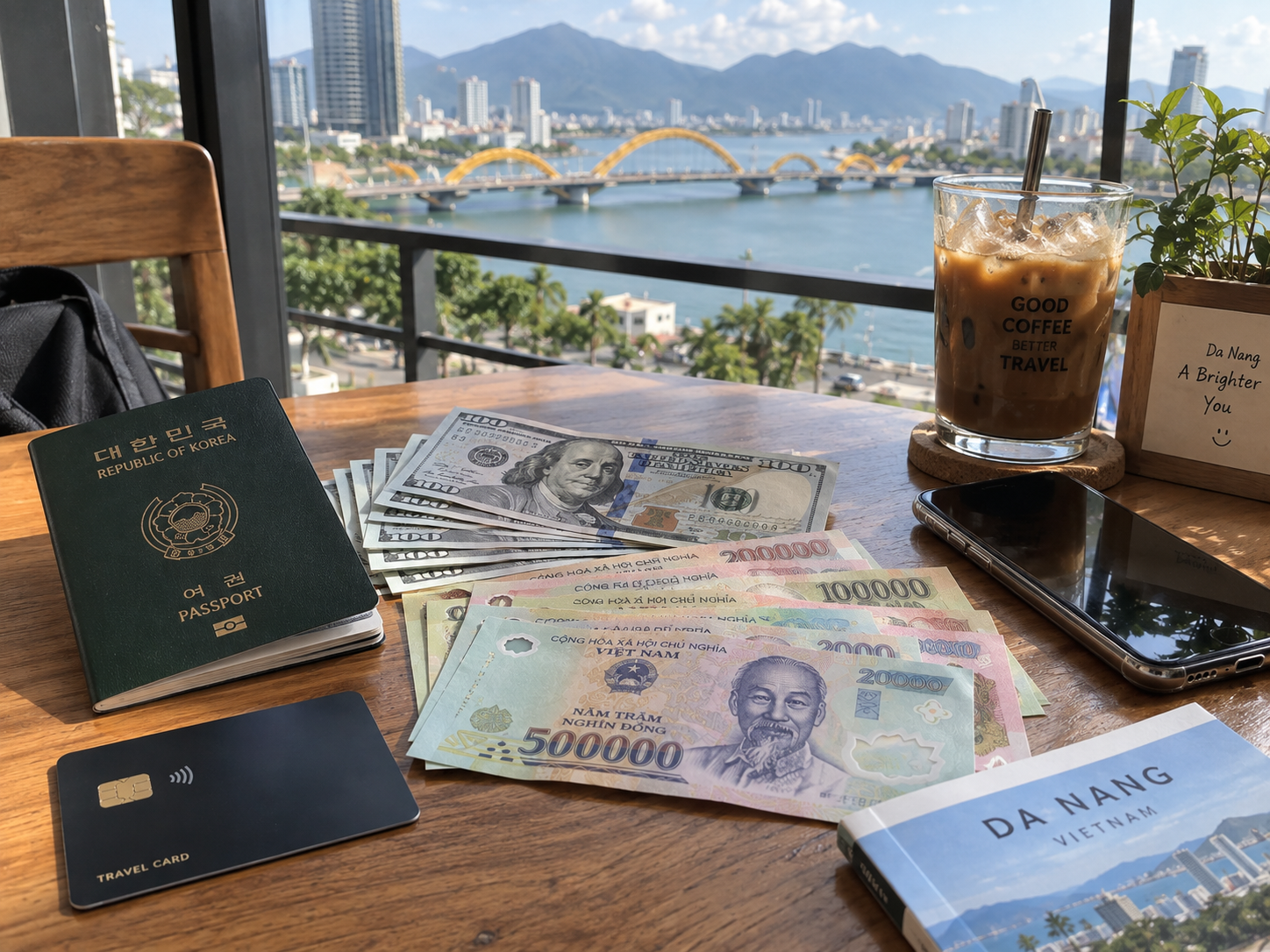
Da Nang Money Exchange Guide 2026: Han Market Gold Shops, USD to VND, ATMs & Cash Tips
Da Nang money exchange is one of the first practical things travelers should understand before arriving in the city.
Should you bring US dollars and exchange them into Vietnamese dong? Should you bring your home currency? Or is it easier to use an international debit or travel card and withdraw VND from an ATM after arrival?
The good news is that all of these options can work well in Da Nang.
Cards are widely accepted at hotels, resorts, shopping malls, supermarkets and many restaurants. However, cash is still very useful at traditional markets, small local restaurants, street-food stalls and independent cafés.
For most travelers, the most practical setup is simple:
International card + some VND cash + a small amount of backup foreign currency.

How Much Cash Can You Bring Into Vietnam?
A common misunderstanding is that travelers are only allowed to bring USD 5,000 into Vietnam.
That is not exactly correct.
USD 5,000 is not the maximum amount you can carry. It is the customs declaration threshold.
If you enter or leave Vietnam carrying more than USD 5,000 in cash, or the equivalent value in another foreign currency, you must declare it to Vietnamese Customs.
For Vietnamese dong, the declaration threshold is more than 15,000,000 VND in cash.
The easiest way to remember it is:
USD 5,000 or less → generally below the declaration threshold
More than USD 5,000 → customs declaration required
The same threshold applies to currencies such as EUR, GBP, AUD and JPY based on their equivalent value in US dollars.
This does not mean that bringing more than USD 5,000 into Vietnam is automatically prohibited. It means that customs declaration procedures apply.
Where Can You Exchange Money in Da Nang?
Travelers in Da Nang generally have four main options:
Airport exchange counters
Banks
City exchange counters and authorized gold-shop exchange businesses
ATMs
Da Nang International Airport has foreign-currency exchange services and ATMs, making it easy to get your first Vietnamese dong immediately after arrival.
The airport officially lists several major currencies at its exchange counters, including USD, EUR, GBP, AUD, CAD, CHF, HKD, JPY, KRW, SGD and THB.
Airport exchange is very convenient, especially if you need cash immediately for transportation or small purchases.
However, if you plan to exchange a larger amount of money, it can be worth exchanging only a small amount at the airport and comparing rates in the city later.
Banks are another reliable choice, although opening hours and identification requirements may make them slightly less convenient for short-term visitors.
Then there is one option that often surprises first-time visitors to Vietnam:
gold shops.
Yes, People Really Exchange Money at Gold Shops in Vietnam
One of the more unusual parts of money exchange in Vietnam is seeing people walk into a gold or jewelry shop with dollars, euros, yen or other foreign currencies and leave with Vietnamese dong.
For travelers from countries where currency exchange is mainly handled by banks or dedicated exchange counters, this can look strange at first.
But it is a familiar part of local money-exchange culture in Vietnam.
In Da Nang, the area around Han Market — Chợ Hàn — is especially well known for this.
Travelers often visit established gold shops near Han Market to exchange USD and other foreign currencies into VND.
However, there is one important thing to remember:
not every gold shop should automatically be treated as an authorized exchange point.
Vietnam has a formal registration system for foreign-exchange agents, so it is better to use established businesses that are currently offering legitimate exchange services rather than informal street exchange.

Two Well-Known Gold Shops Near Han Market
Two names commonly known among travelers in the Han Market area are Tiệm Vàng Soạn Hà and Tiệm Vàng Kim Yến.
Tiệm Vàng Soạn Hà
Soạn Hà is located close to Han Market, making it easy to visit while exploring central Da Nang.
Google Maps:
https://share.google/1YW5FVYbwSPy3KzJz
Tiệm Vàng Kim Yến
Kim Yến is another well-known gold shop near Han Market where travelers commonly compare foreign-currency exchange rates.
Google Maps:
https://share.google/LhTyR0X1clwI2i3z0
Because the two places are in the same general area, it is easy to ask both shops for a quote before exchanging.
A simple question is enough:
“100 USD, how much?”
Staff will normally show you the amount you will receive in Vietnamese dong on a calculator.
Why Are Gold Shops Popular for Money Exchange?
The biggest reason is simple:
the exchange rates can be very competitive.
Well-known exchange businesses around Han Market often offer cash rates close to the broader market exchange rate.
The process is also straightforward.
You show the foreign currency you want to exchange, and the staff show you the final amount of VND you will receive.
In many cases there is no separate commission added after the quote. Instead, the business margin is effectively reflected in the exchange-rate spread.
So rather than worrying about the word “commission,” the easiest comparison is:
How many Vietnamese dong will I actually receive for USD 100?
That is the number that matters most.
Actual USD Exchange Rate We Checked on September 10, 2026
We checked an actual USD cash exchange rate near Han Market in Da Nang on September 10, 2026.
The amount offered was:
USD 100 = 2,575,000 VND
That works out to:
USD 1 = 25,750 VND
At the time, the broader USD/VND reference rate was around 25,900 VND per US dollar, meaning the cash exchange rate was very close to the market reference.
The difference on USD 100 was only around 15,000 VND, or roughly 0.6%.
That is a very competitive result for a physical cash exchange.
Exchange rates move every day, so do not expect USD 100 to always equal 2,575,000 VND.
Before exchanging money, simply search:
“1 USD to VND”
and compare the current market rate with the amount the exchange shop offers.

Do You Need to Bring US Dollars?
Not necessarily.
Many exchange businesses in Da Nang tourist areas handle more than just USD.
Depending on the shop, you may find currencies such as:
EUR
JPY
KRW
AUD
GBP
CNY
SGD
If your home currency can be exchanged directly into VND at a reasonable rate, there may be no reason to convert it into US dollars first.
For example:
Home Currency → VND
may be better than:
Home Currency → USD → VND
because converting twice can expose you to two exchange-rate spreads.
For travelers whose home currency is difficult to exchange in Vietnam, USD or EUR can still be convenient backup currencies.
A Very Vietnamese Detail: The Condition of Your Banknote Can Matter
Here is one detail that surprises many travelers.
At some cash exchange businesses in Vietnam, the condition of a foreign banknote can affect the rate slightly.
For example, two USD 100 notes may have exactly the same face value, but a heavily creased, stained, written-on or damaged note may receive a slightly worse rate than a clean note.
A badly damaged banknote may sometimes be refused altogether.
You may also see staff inspect Japanese yen, Korean won and other foreign banknotes before accepting them.
It is one of the distinctive details of cash exchange culture in Vietnam.
However, the difference is usually not very large.
There is no need to worry about every small crease, but if you are bringing foreign cash specifically to exchange, clean and undamaged banknotes are the safest option.
Some exchange businesses may also offer slightly better rates for higher denominations such as USD 50 or USD 100 compared with small-dollar notes.

The Easiest Way to Understand Vietnamese Dong
Vietnamese prices can look intimidating at first because of all the zeros.
A restaurant price of 100,000 VND may sound huge until you realize it is only around four US dollars.
There is a very easy mental shortcut:
25,000 VND ≈ USD 1
This means:
50,000 VND ≈ USD 2
100,000 VND ≈ USD 4
250,000 VND ≈ USD 10
500,000 VND ≈ USD 20
1,000,000 VND ≈ USD 40
If you want to calculate it yourself, remove the final three zeros and divide the remaining number by about 25.
For example:
100,000 VND → 100 ÷ 25 ≈ USD 4
This is only a quick travel calculation, not an exact live exchange rate, but it is extremely useful when looking at restaurant menus, taxi fares, massages or café prices.
What Can 100,000 VND Buy in Da Nang?
Another easy way to understand Vietnamese money is to think about what it can actually buy.
100,000 VND is roughly USD 3 to 4.
In Da Nang, that amount can commonly cover:
one simple local bowl of pho
one or two café drinks
a light local meal
several small snacks or drinks from local vendors
If you go to inexpensive neighborhood restaurants or street stalls, the money can sometimes stretch much further.
At very cheap local places, 100,000 VND may sometimes be enough for two or even three simple noodle bowls, or around three to four basic local coffees.
Prices will naturally be higher at beachfront cafés, hotels, tourist restaurants and more stylish venues.
So the easiest way to remember it is:
100,000 VND ≈ USD 4 ≈ one casual local meal or a small café stop.

What If You Do Not Bring Cash? Use an ATM
For many international travelers, using an ATM is actually the simplest option.
If you have an international debit card, travel card or bank card that supports overseas withdrawals, you can withdraw Vietnamese dong after arriving in Da Nang.
ATMs accepting international cards are widely available in major Vietnamese cities and at major airports.
The easiest way to find one in Da Nang is to search Google Maps using a bank name plus “ATM.”
Useful searches include:
VPBank ATM
Agribank ATM
Vietcombank ATM
BIDV ATM
VietinBank ATM
ACB ATM
Techcombank ATM
Sacombank ATM
MB Bank ATM
VIB ATM
For example, if you are staying around My Khe Beach, try searching:
“VPBank ATM near My Khe Beach”
or simply:
“Agribank ATM”
If possible, using an ATM attached to an actual bank branch can be more convenient than using an isolated machine on the street, especially if your card is retained or you need assistance.
Most ATMs Are Easy to Use in English
Many major-bank ATMs in Vietnam provide an English-language option.
That means basic cash withdrawal is usually straightforward even if you do not speak Vietnamese.
The general process is:
English → Withdrawal → Choose amount → Confirm → Receive VND
The wording may vary slightly depending on the bank and ATM.

How Much Can You Withdraw From an ATM in Vietnam?
The maximum amount varies depending on the ATM, the Vietnamese bank and your own card issuer.
As a general travel guide, local-bank ATMs may have per-transaction limits around:
2,000,000 VND ≈ USD 77
3,000,000 VND ≈ USD 116
Some machines, particularly higher-limit or international-bank ATMs, may allow:
5,000,000 VND ≈ USD 193
10,000,000 VND ≈ USD 386
These numbers are not guaranteed limits for every machine.
The actual amount available depends on:
the ATM’s own transaction limit
the Vietnamese bank
your international card
your card issuer’s overseas withdrawal limit
Always check the amount displayed on the ATM itself.
Sometimes an ATM Simply Has No Cash
If an ATM rejects your withdrawal, it does not always mean there is a problem with your card.
Sometimes the machine may simply be low on cash or temporarily out of certain banknotes.
This can happen during periods of high demand, weekends or major holidays.
If one machine does not work, do not immediately panic.
Try another ATM from the same bank or search Google Maps for another nearby bank such as VPBank, Agribank, Vietcombank or BIDV.

The Most Important ATM Rule: Choose VND
When using an international card, an ATM may ask:
“Would you like to be charged in your home currency?”
or offer to convert your withdrawal into USD, EUR, GBP or another currency.
This is called Dynamic Currency Conversion, or DCC.
It means the ATM operator offers to perform the conversion using its own exchange rate.
Unless you have specifically compared the offered rate, a useful default rule is:
Home Currency or VND? → Choose VND
Accept Conversion? → Decline Conversion
Declining the conversion does not cancel the cash withdrawal.
It simply means you are declining the ATM operator’s currency conversion and allowing your own card network or bank to handle the exchange instead.
ATM Fees Can Vary
ATM withdrawals can involve several separate costs:
Vietnamese ATM operator fee
your own bank’s overseas cash withdrawal fee
the exchange rate applied to the transaction
Because of this, two different ATMs can result in different total costs.
If an ATM shows a fee that seems too high before confirmation, you can cancel the transaction and try another bank.
It is also worth checking your own bank or travel card’s overseas withdrawal policy before your trip.
Can You Travel Around Da Nang Using Only Cards?
In many places, yes.
But relying on cards alone is not ideal.
International cards are useful at:
hotels
resorts
shopping malls
supermarkets
larger restaurants
chain cafés
spas
tour companies
Cash is still useful at:
traditional markets
street-food stalls
small local restaurants
independent cafés
small shops
For most travelers, the most practical combination is still:
International card + some VND cash + a little backup cash.
Check Your Vietnamese Banknotes Before Walking Away
Vietnamese money comes in large-looking denominations such as:
20,000 VND
50,000 VND
100,000 VND
200,000 VND
500,000 VND
After exchanging money, take a moment to count the total amount before leaving the counter.
It is also useful to have smaller denominations.
If all of your money is in 500,000 VND notes, paying for a small coffee, snack or street-food meal can be inconvenient.
If possible, ask for a mix of:
20,000 VND
50,000 VND
100,000 VND
for everyday spending.

Avoid Informal Street Currency Exchange
If someone approaches you in a tourist area and offers an unusually attractive exchange rate, there is little reason to take unnecessary risks.
Vietnam has a formal registration system for businesses operating as foreign-currency exchange agents.
For a safer transaction, use an established exchange business, bank or ATM instead of following an unknown individual to an informal exchange location.
A tiny difference in the exchange rate is rarely worth the risk.
Final Thoughts: What Is the Best Way to Handle Money in Da Nang?
There is no single best method for every traveler.
If you already have USD, EUR or another widely exchanged currency, comparing cash exchange rates at established businesses around Han Market can be a very practical option.
On September 10, 2026, the real cash rate we checked was:
USD 100 = 2,575,000 VND
If your own currency receives a good direct exchange rate in Da Nang, there may be no reason to convert it into US dollars first.
If you prefer not to carry much cash, international debit cards and travel cards make ATM withdrawals convenient.
And if Vietnamese prices still look confusing, just remember two simple numbers:
USD 1 ≈ 25,000 VND
100,000 VND ≈ USD 4
Around 100,000 VND can often cover a simple local meal or one or two café drinks in Da Nang, while cheaper local stalls can stretch the same amount even further.
For most travelers, the best strategy is simple:
compare rates quickly, use reputable places, carry some Vietnamese dong, keep a backup payment method and do not overcomplicate it.
Frequently Asked Questions
Where is the best place to exchange money in Da Nang?
Han Market is one of the most popular areas for cash exchange. Established gold shops and exchange businesses nearby often offer competitive cash rates, but rates change daily, so compare the final amount offered before exchanging.
Can tourists exchange money at gold shops in Vietnam?
Foreign-currency exchange at established gold or jewelry businesses is common in Vietnam, but not every gold shop is automatically an authorized exchange agent. Use reputable places that are currently offering legitimate exchange services.
How much was USD 100 worth in Da Nang on September 10, 2026?
The actual cash exchange quote we checked was USD 100 = 2,575,000 VND.
Should I bring USD to Da Nang?
USD is easy to exchange, but it is not always necessary. If your own home currency can be exchanged directly into VND at a reasonable rate, direct conversion may save you from exchanging twice.
How much foreign cash can I bring into Vietnam without declaring it?
The customs declaration threshold is more than USD 5,000 in foreign cash, or an equivalent amount in another currency. For Vietnamese dong, the threshold is more than 15,000,000 VND.
Are ATMs easy to find in Da Nang?
Yes. Search Google Maps for VPBank ATM, Agribank ATM, Vietcombank ATM, BIDV ATM, ACB ATM, Techcombank ATM, MB Bank ATM or VIB ATM.
Do ATMs in Vietnam support English?
Many major-bank ATMs provide English-language menus, making basic withdrawals relatively easy for international travelers.
How much can I withdraw from an ATM at one time?
Limits vary. A general range is around 2 to 3 million VND per transaction at many local-bank ATMs, while some machines can allow 5 to 10 million VND.
What should I choose if an ATM asks between my home currency and VND?
Choose VND and generally decline the ATM’s Dynamic Currency Conversion unless you have specifically compared and accepted the offered conversion rate.
What is the easiest way to calculate VND in US dollars?
For quick travel calculations, remember that about 25,000 VND is roughly equal to USD 1. Therefore, 100,000 VND is roughly USD 4.