Vietnamese Dining Etiquette: 12 Things I Learned Living in Vietnam
Vietnamese Dining Etiquette: 12 Things I Learned Living in Vietnam
When I first moved to Vietnam, I didn’t think dining etiquette would be something I needed to learn.
I’m Korean, so a Vietnamese dining table already felt strangely familiar.
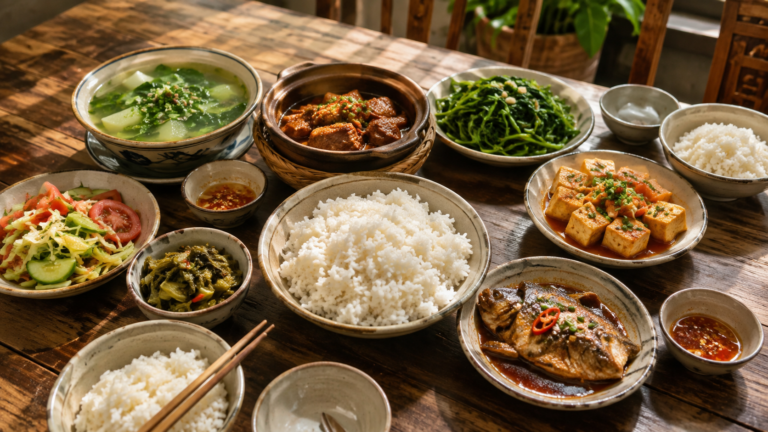
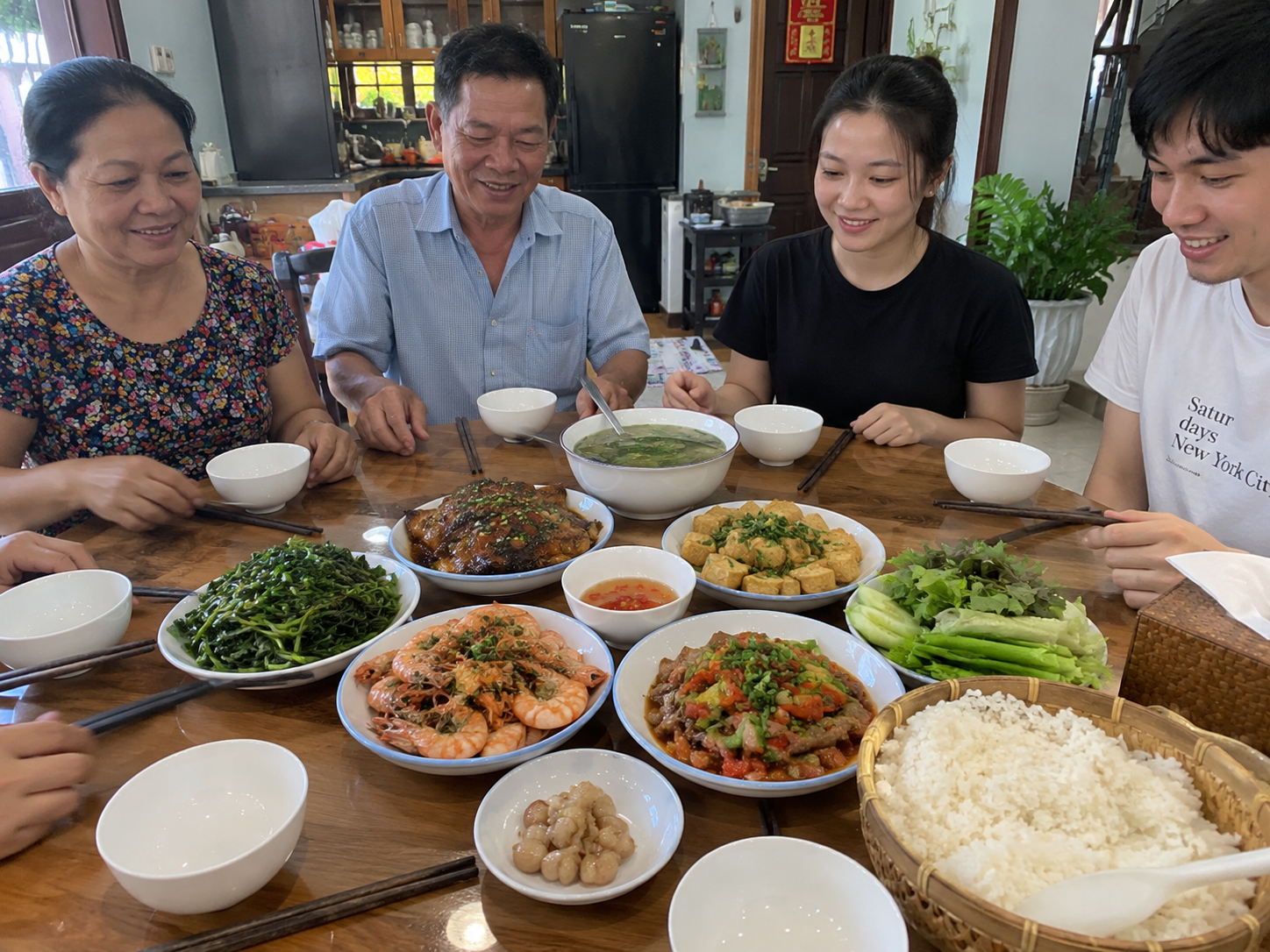
Rice on the table. Chopsticks in everyone’s hands. Several dishes placed in the middle. Soup, vegetables, meat or fish shared between everyone. Younger people paying attention to older family members.
My first impression was basically:
“This is pretty similar to Korea.”
But after living in Da Nang and spending more time eating with Vietnamese families, friends and restaurant staff, I started noticing the differences.
They weren’t huge differences.
They were small habits.
The way people invite others to start eating. The way food is shared. The importance of dipping sauces. What people do with chopsticks. How quickly a quiet dinner changes once someone orders beer.
These things are difficult to understand from a travel guide alone.
And honestly, Vietnamese dining etiquette isn’t nearly as strict as some articles make it sound.
You don’t have to memorize 30 rules before eating a bowl of phở.
But understanding a few customs can make eating with Vietnamese people much more enjoyable.
Here are the things I’ve noticed most while living in Vietnam.
1. Vietnamese Dining Culture Felt Familiar to Me — At First
There are obvious similarities between Korea and Vietnam.
Both countries have a strong rice culture, and chopsticks are part of everyday meals.
Family meals are also important.
Instead of every person always ordering one large individual plate, it’s very common to put several dishes in the middle and eat them together.
That part never felt strange to me.
In Korea, we also grow up eating rice with soup, side dishes and shared food.
But the longer I lived in Vietnam, the more I realized that similar-looking dining tables don’t necessarily mean identical dining cultures.
Vietnam has its own rhythm.
And one of the first differences I noticed was something I kept hearing before people started eating.
2. The Vietnamese “Mời” Culture
If you eat with a Vietnamese family, there’s a good chance you’ll hear the word:
“Mời.”
For example:
Mời bố mẹ ăn cơm.
Mời anh ăn cơm.
Mời chị ăn cơm.
A direct English translation can sound a little awkward.
“Mời” can mean something close to “please,” “I invite you,” or “please enjoy.”
At a family meal, younger people may say it to parents, grandparents or older relatives before eating.
As a Korean, I immediately understood the feeling behind it.
Korean culture also traditionally teaches younger people not to simply start eating before older family members.
But Vietnamese people often express this respect verbally.
That was interesting to me.
The first few times you hear several people saying “mời” around the table, it can almost sound ceremonial.
After living here for a while, though, it starts to feel completely normal.
What should a foreign visitor do?
You don’t need to memorize a long Vietnamese sentence.
If you’re eating with a family, simply wait a moment and follow what everyone else is doing.
If you learn how to use “mời”, even better.
Vietnamese people usually appreciate the effort.

3. Don’t Rush to Take the First Bite
This is especially important when you’re invited to someone’s home.
At a restaurant with friends, things are naturally more relaxed.
But at a family gathering, wedding meal or dinner with older relatives, I think it’s better to look around before immediately grabbing food.
Has everyone sat down?
Are the older people ready?
Has someone said “mời”?
This doesn’t mean you have to sit perfectly still waiting for permission.
Vietnamese meals aren’t military ceremonies.
It’s more about awareness.
That part feels familiar to me as a Korean.
Sometimes good etiquette isn’t about knowing a rule.
It’s just noticing the people around you.
4. Food in the Middle Usually Belongs to Everyone
One of the most common sights at a Vietnamese meal is a table completely covered with food.
There might be:
- a plate of fish
- stir-fried vegetables
- pork or chicken
- soup
- rice
- herbs
- several dipping sauces
Most of it is shared.
This sounds obvious to people from many Asian countries, but I’ve seen foreign visitors hesitate because they’re used to receiving one main dish for themselves.
Vietnamese meals often work differently.
You take a little food from the middle, eat it with rice, then try something else.
You don’t have to decide which plate is “your dish.”
The entire table is part of the meal.
My advice is simple:
Take a small amount first.
You can always take more later.
It’s more comfortable than immediately taking the biggest piece on the plate.

5. Your Small Bowl Does More Work Than You Think
Vietnamese tables can look complicated when you’re not used to them.
You may have:
- chopsticks
- a spoon
- a rice bowl
- a small sauce dish
- soup
- shared plates
- herbs
- vegetables
But there isn’t really anything complicated about it.
The small bowl in front of you becomes your personal space.
You can put rice in it, place pieces of meat or vegetables on top, add a little sauce or hold it closer while eating.
In Korea, I’m also used to bowls and chopsticks, so this wasn’t difficult for me.
But I did notice that Vietnamese meals often involve constant movement between different foods.
Rice.
A piece of fish.
A little vegetable.
Some herbs.
A dip into sauce.
Back to the rice.
That’s part of what makes Vietnamese family meals enjoyable.
6. Don’t Stick Chopsticks Upright in Your Rice
This is probably the best-known chopstick rule in Vietnam.
Don’t leave chopsticks standing vertically in a bowl of rice.
The reason is that it can resemble incense sticks associated with offerings to the deceased.
This custom isn’t unique to Vietnam, so many Asian visitors already understand it.
As a Korean, it wasn’t something I needed to learn after moving here.
Still, it’s probably the one chopstick rule I’d tell first-time visitors to remember.
When you’re finished eating or want to put your chopsticks down, simply place them beside your bowl or in the way your host or restaurant has arranged.
Also avoid things like:
- pointing directly at someone with chopsticks
- playing with them
- banging them on bowls
- digging through a shared plate looking for one particular piece
That last one may not always be a traditional taboo.
It’s just bad table manners anywhere.
Avoid leaving chopsticks standing vertically in rice. Place them beside your bowl instead.

7. Dipping Sauces Are Not Just Side Decorations
If there’s one thing I think visitors underestimate about Vietnamese food, it’s the sauce.
Vietnamese food isn’t just about phở, bánh xèo or grilled meat.
The sauce can completely change the dish.
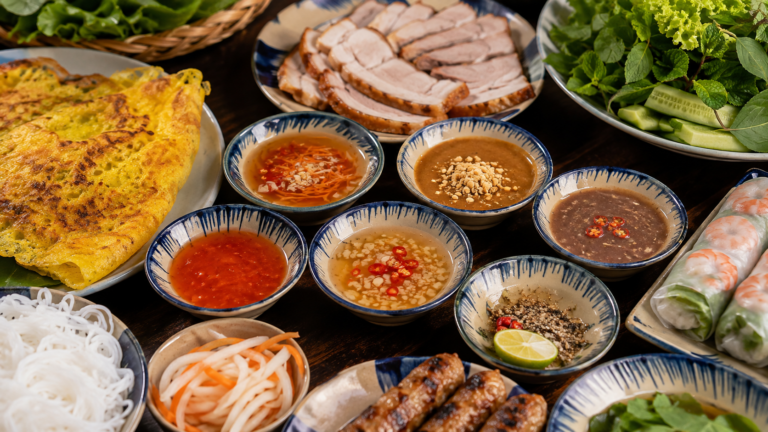
The most famous example is nước mắm, but there are many different sauces depending on what you’re eating.
Some are sweet.
Some are salty.
Some contain garlic or chili.
Some are surprisingly strong if you aren’t used to fish sauce.
And sometimes two dishes sitting next to each other are supposed to be eaten with completely different sauces.
When I don’t know how to eat a Vietnamese dish, I’ve learned not to guess.
I watch the Vietnamese person next to me.
That’s usually the fastest way to understand it.
Which herbs do they use?
Do they wrap the food?
Which sauce do they dip it into?
Do they put it into the bowl first?
You can learn more in 20 seconds by watching someone eat than by reading a long explanation.

8. Fresh Herbs Can Be Part of the Dish, Not Decoration
This was one of the biggest differences I noticed compared with eating Vietnamese food outside Vietnam.
You order something and suddenly a huge basket of green leaves arrives.
The first reaction can be:
“Am I supposed to eat all of this?”
Usually, yes.
Vietnamese cuisine uses an incredible variety of fresh herbs and vegetables.
Depending on the dish, you may wrap food in lettuce or rice paper, add herbs to noodles, eat them with grilled meat or dip everything together into sauce.
At first, some herbs may taste unusually strong.
After living here longer, I’ve come to feel that many Vietnamese dishes actually taste incomplete without them.
If you’re unsure, again, watch the people around you.
Vietnamese people are usually happy to show foreigners how a dish is supposed to be eaten.

9. Someone May Put Food Into Your Bowl
This is another part of Vietnamese dining culture that feels very familiar to me as a Korean.
Someone may suddenly put a piece of meat, fish or another good part of the dish into your bowl.
Especially if you’re a guest.
The message is basically:
“Try this.”
Or:
“This piece is good.”
Or simply:
“Eat more.”
I don’t find this strange because Korean families do similar things.
In fact, Vietnamese mothers and Korean mothers probably have a lot in common when it comes to making sure everyone has eaten enough.
Sometimes you think you’re finished.
Then someone adds another piece to your bowl.
Congratulations.
You’re eating again.
Usually, it’s a gesture of hospitality.
10. Whole Fish, Bones and Shells Are Normal
Vietnamese food can sometimes involve more work than visitors expect.
Fish may come to the table whole.
Chicken may contain bones.
Shrimp may still have shells.
Seafood might require your hands.
This isn’t unusual.
I’ve noticed that visitors who are used to completely deboned or pre-cleaned food can sometimes be surprised.
But in Vietnam, seeing the original form of the ingredient is normal.
And sometimes the best part of the dish is exactly the part you’d never receive in a heavily processed meal.
Don’t panic if eating becomes slightly messy.
Look around.
Everyone else is probably dealing with exactly the same thing.

11. Vietnamese Drinking Culture Can Change the Entire Table
A calm dinner can become very loud once beer appears.
If you’ve spent time in Vietnam, you’ve probably heard:
“Một, hai, ba, dô!”
One, two, three — cheers!
Then another toast.
Then another.
Then two people at the other end of the table suddenly decide they also need a private toast.
Vietnamese drinking culture can be extremely social.
Groups of friends, coworkers and relatives may toast many times during one meal.
As a foreigner, you can join the fun without feeling that you have to drink heavily.
You can take small sips or explain that you don’t drink much.
The social participation is often more important than trying to prove how much alcohol you can handle.
And yes:
Vietnamese dinners can get loud.
Very loud.
That’s part of the atmosphere.

12. Eating With Vietnamese People Taught Me More Than Restaurants Alone
Before living in Vietnam, Vietnamese food meant individual dishes to me.
Phở.
Bánh mì.
Bánh xèo.
Bún chả.
Mì Quảng.
After living here, I think differently.
Vietnamese food isn’t only the recipe.
It’s also the table.
It’s people sharing food.
Someone giving you the best piece.
Someone asking you to try another sauce.
Someone showing you how to wrap a piece of bánh xèo properly.
Someone saying “mời” before the meal begins.
This is something that’s difficult to understand when you only visit a famous restaurant, order one dish and leave.
Eating with Vietnamese people taught me that how the food is eaten is part of the food itself.
Vietnamese vs Korean Dining Etiquette: Similar but Not the Same
As a Korean living in Vietnam, this is probably the comparison I naturally make most often.
There are a lot of similarities.
Things that feel familiar to me
Both cultures commonly:
- eat rice as a staple
- use chopsticks
- share dishes
- respect older family members
- treat meals as social occasions
- encourage guests to eat more
- place multiple foods on the table at once
But there are also differences.
Vietnamese meals tend to use more fresh herbs and raw vegetables than typical Korean meals.
The “mời” habit is also expressed much more clearly in Vietnamese family dining.
And Vietnamese dipping sauces are often matched very specifically to individual dishes.
Korean meals have plenty of sauces and fermented condiments too, but the Vietnamese habit of combining herbs, rice paper, meat and a particular dipping sauce creates a very different eating experience.
From a distance, the two cultures can look almost identical.
Once you’ve lived inside both, the small differences become the interesting part.

Vietnamese Dining Etiquette for Tourists: The Simple Version
If you’re visiting Vietnam for the first time, you don’t need to memorize everything in this article.
Remember these basics:
- Don’t stick chopsticks vertically into rice.
- Wait a moment before eating when you’re a guest at a family meal.
- Understand that dishes in the center are usually shared.
- Take small portions first.
- Watch how locals combine herbs, rice paper and dipping sauces.
- Respect older people at the table.
- Don’t worry about being perfect.
- If you don’t know how to eat something, ask.
That last rule might be the most useful one.
I’ve rarely seen Vietnamese people become annoyed because a foreign visitor didn’t know how to eat a local dish.
Usually, the opposite happens.
Someone immediately starts explaining it.
Then three other people explain it differently.
And now you have four Vietnamese people teaching you how to eat one piece of bánh xèo.
That’s Vietnam.
Do Foreigners Need to Follow Every Vietnamese Table Manner?
No.
This is something I think many travel articles make unnecessarily complicated.
Vietnamese people understand that visitors don’t know every local custom.
Nobody expects someone who arrived yesterday to behave exactly like a Vietnamese grandmother who has followed the same family habits for 70 years.
Making a sincere effort is enough.
Be polite.
Observe.
Try the food.
Show appreciation when someone shares something with you.
Those things matter much more than memorizing a list.
What I’ve Learned Living in Da Nang
Living in Da Nang has changed the way I understand Vietnamese food.
When you’re traveling, it’s natural to focus on famous dishes.
You search for the best phở.
The best bánh xèo.
The best seafood.
I still do that too.
But after living here, I’ve realized that some of my strongest food memories aren’t about one particular dish.
They’re about the table.
Eating together.
Watching everyone reach toward the same plate.
Trying a sauce I didn’t recognize.
Learning which herb goes with which food.
Hearing “mời” before people start eating.
Watching a quiet meal turn into a loud drinking session after the first few beers.
These small moments made Vietnamese food feel less like something I was visiting and more like part of everyday life.
For me, that’s one of the best things about living here.
Understanding Vietnamese food isn’t only about knowing what to order.
It’s also about learning how Vietnamese people eat together.
FAQ: Vietnamese Dining Etiquette
Is it rude to stick chopsticks in rice in Vietnam?
Yes, it’s best to avoid leaving chopsticks standing vertically in a bowl of rice. The image can resemble incense used in rituals and offerings for the deceased.
Should I wait for older people before eating in Vietnam?
When eating with a Vietnamese family, especially with older relatives present, it’s polite to wait briefly and follow the host’s lead before beginning.
What does “mời” mean before a Vietnamese meal?
“Mời” is a polite expression used to invite or encourage another person to eat. Younger family members may use it when speaking to parents, grandparents or older relatives.
Do Vietnamese people share food?
Very often. At family meals, several dishes are usually placed in the center of the table and shared.
Can I use my hands when eating Vietnamese food?
For some dishes, yes. Foods involving rice paper, shell-on seafood or certain snacks are often easier to eat with your hands.
What is “Một, hai, ba, dô”?
It literally follows “one, two, three,” and is a very common Vietnamese drinking cheer, similar to saying “cheers!”
Will Vietnamese people be offended if I don’t know the etiquette?
Usually not. Foreign visitors aren’t expected to know every local custom. Being respectful and observing the people around you is normally enough.